
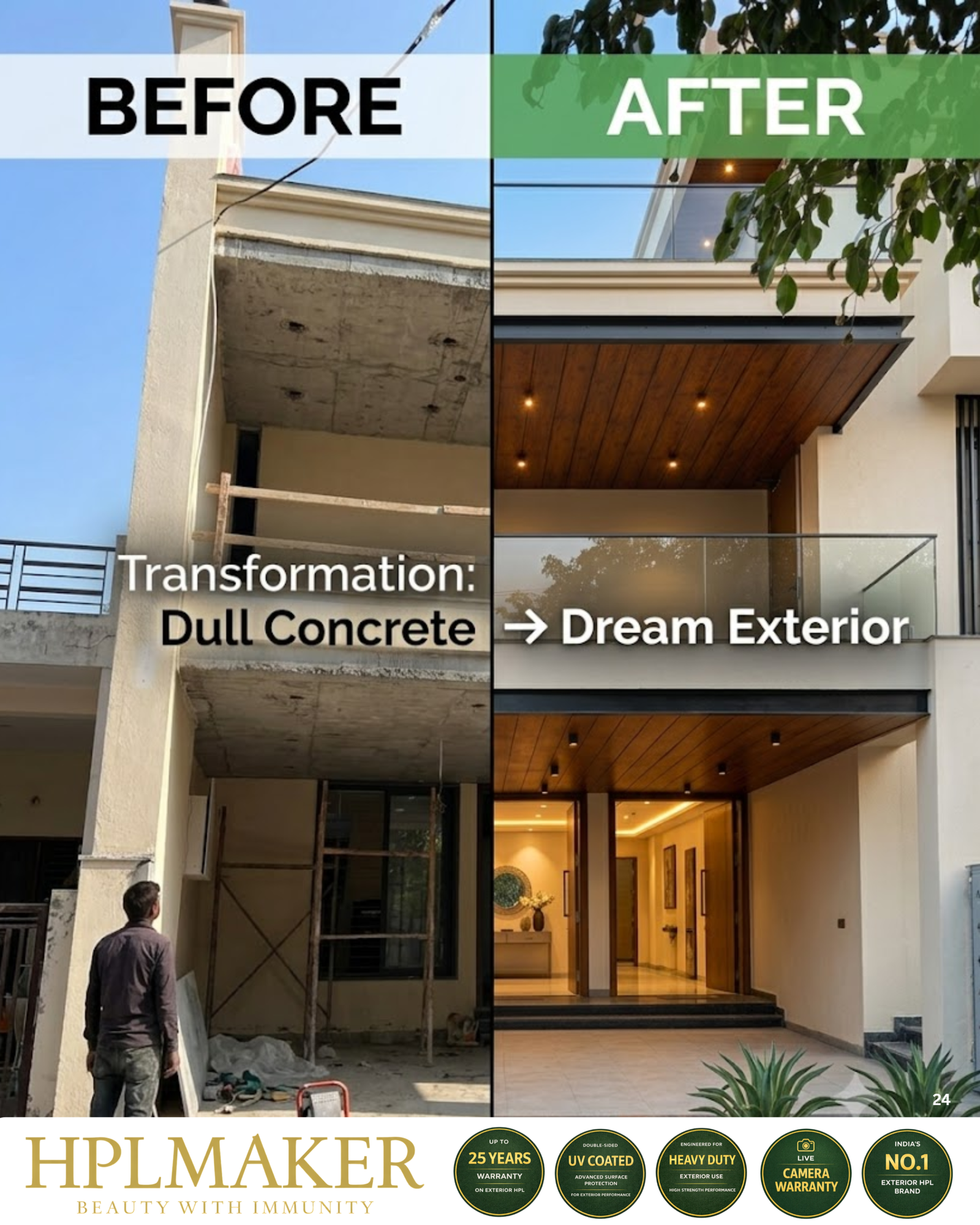
The 2026 exterior palette is drawn directly from nature: bark-inspired browns, mineral beiges, soft greys and matte blacks. These tones are popular because they age gracefully and integrate with stone, brick and timber. But how they perform in Indian conditions varies significantly, and that should influence where you place them.
The Five Defining Tones
1. Bark browns and warm woods
The dominant family. Cedar, walnut and ipe tones carry the biophilic trend and suit almost every architectural style.
Indian performance: excellent. Mid-tone browns hide dust and rain streaking better than any other family, which matters enormously in Delhi NCR, Rajasthan and anywhere near active construction. This is the safest specification in the palette.
2. Matte black and deep charcoal
The statement colour of 2026, replacing gloss finishes.
Indian performance: visually superb, thermally demanding. Needs ventilated construction and is best used as accent rather than field, ideally on north and east elevations. Shows dust in dry regions.
3. Mineral beiges and sand tones
Warm neutrals that sit between the browns and the greys.
Indian performance: very good. Low solar absorption, reasonable dust concealment, and they read well against the strong natural light most of India gets. Underused relative to their suitability.
4. Soft and mid greys
The contemporary default, and the most flexible for combining with other finishes.
Indian performance: good in mid tones. Very light greys show streaking below sills and ledges; very dark greys behave like charcoal thermally.
5. Stone and mineral textures
Not a colour exactly, but the textured mineral finishes belong in this conversation.
Indian performance: excellent dust concealment and very forgiving of surface marks. Works best at scale on larger elevation masses.
What Has Moved Out
- High gloss — reads dated and shows every imperfection
- Saturated primary colours — except as deliberate brand elements on commercial frontages
- Bright white — impractical in most Indian locations; dust and streaking appear within weeks
- Heavy multi-colour compositions — three or more finishes now reads as busy rather than designed
Composition Guidance
Two finishes is the working maximum for most elevations, with one clearly dominant at roughly 70 to 80 percent of the area. Combinations that consistently hold up:
- Warm wood plus mid grey — the most reliable contemporary pairing
- Stone texture plus wood accent — mass and warmth
- Mineral beige plus matte black — neutral field with sharp definition
Practical Factors That Override Trend
Local dust. In high-dust regions, mid-tones win regardless of what is fashionable. A trending colour that looks filthy for nine months of the year is a failed specification.
Orientation. Dark surfaces on south and west faces add cooling load. Place them where they cost less.
Existing elements. Window frames, railings and roof edges are usually fixed. Coordinate deliberately rather than hoping.
Longevity of the look. Cladding is a fifteen to twenty-five year decision. Mid-tone woods, warm greys and stone finishes will still read well in a decade. Highly specific trend colours may not.
Frequently Asked Questions
Which facade colours are trending in 2026?
Bark-inspired browns, mineral beiges, soft greys and matte blacks, generally in matte rather than gloss finishes.
Which colours perform best in Indian conditions?
Mid-tone woods and mineral beiges, for dust concealment and lower solar absorption.
How many colours should one facade use?
Two, with one dominant at around 70 to 80 percent of the area.
Should I always see a physical sample?
Yes. Screen and print reproduction of facade colours is unreliable; check samples in natural daylight at multiple times of day.
Planning your palette? Contact HPLMaker for the current shade range and physical samples.